
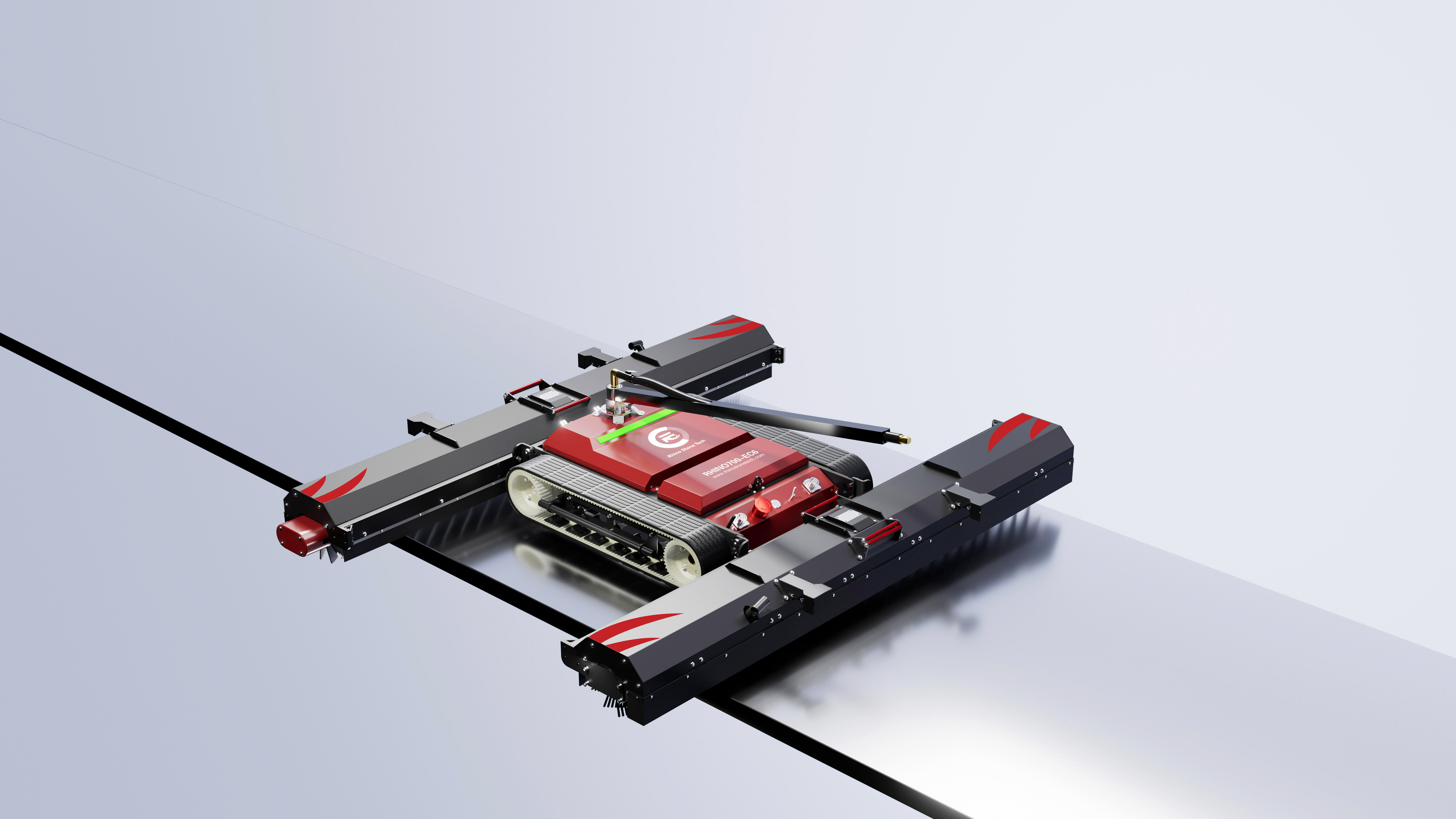
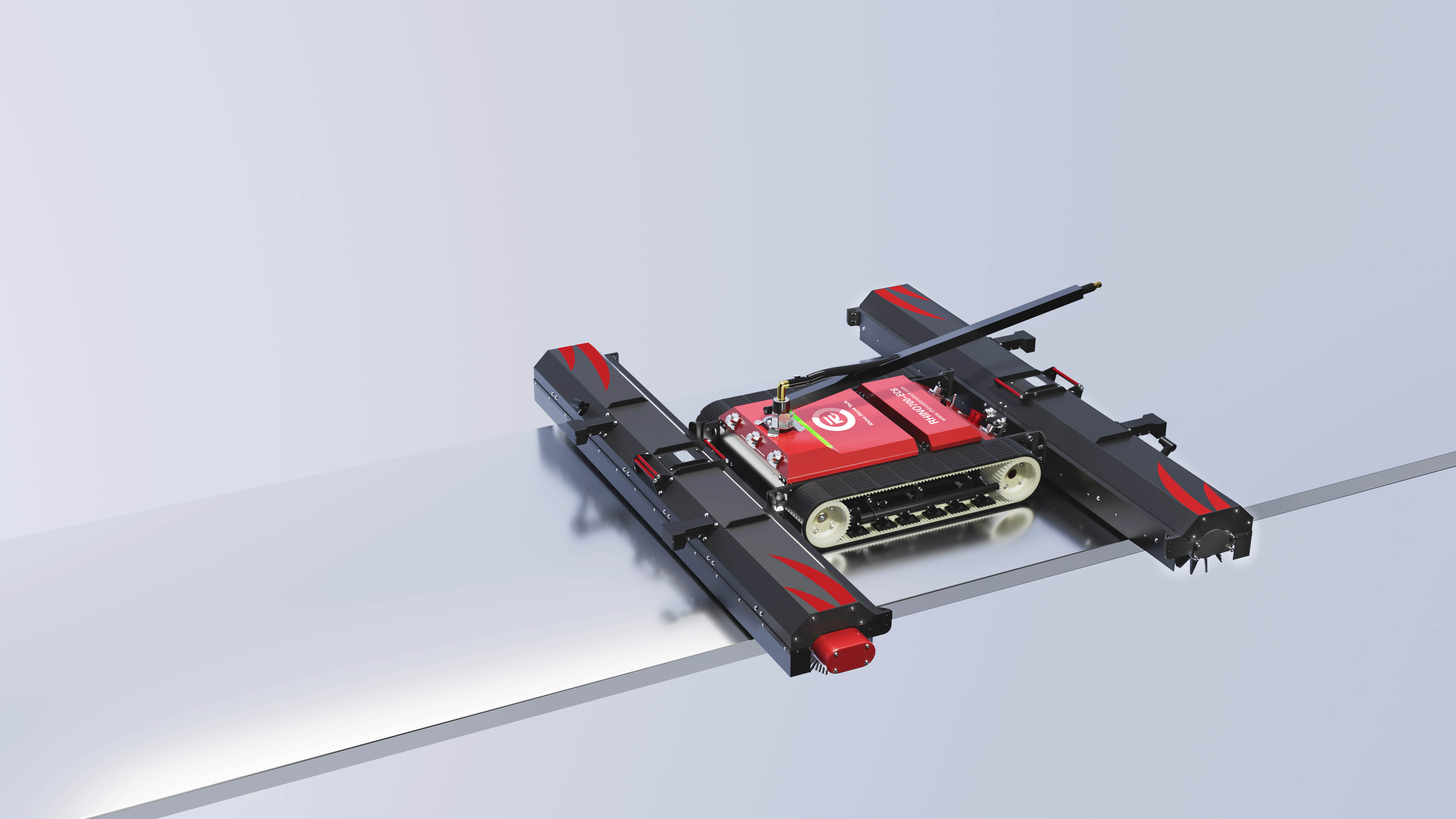
A crawler-type solar panel cleaning robot spends its working day on a surface that ends. Rows stop at a parapet, a walkway, or the open water under a floating array. The tracks grip glass and aluminum, the cleaning head keeps turning, and the machine keeps moving, so the only thing between a working robot and a long drop is a small set of sensors plus the person holding the remote. Understanding how those sensors read an edge, where they sit under the chassis, and what happens in the seconds after a warning changes how buyers judge safety claims. It also explains why no sensor package turns a remote-controlled machine into an unattended one.
How Anti-Fall Sensors Detect Solar Array Edges Before a Crawler Reaches Them
Edge detection starts with a sensor looking down, not forward. An anti-fall sensor on a crawler robot usually emits a short-range signal — infrared light, ultrasound, or a similar proximity method — toward the surface just ahead of or beneath the chassis, then reads what comes back. On a module, glass returns a clean, steady reflection. At the last row of a rooftop array, the surface simply ends and the return disappears. That change is the trigger: the controller treats it as lost ground and cuts drive to the tracks. The key detail is that the sensor is not measuring the roof, it is measuring the absence of roof, and that absence arrives a fraction of a second before the machine does. Panel gaps make the job harder than it first appears. Modules sit in rows with expansion joints, mounting rails, and drainage gaps between them, and a narrow joint can look like a drop-off to a downward-facing sensor. Machines with a long obstacle-crossing range, such as the 60 cm figure on the RHINOSTAR-EC6, are designed to travel over those joints instead of stopping at each one, so the controller has to separate a crossable gap from a genuine array edge. Surface condition and travel speed both shift that judgment. A wet cleaning pass leaves a water film that changes how the surface reflects an infrared beam, dry dust changes it again, and higher speed shortens the time between detection and arrival. Either the sensor sees further ahead, or the machine slows down near a boundary — those are the two practical options.
Why Sensor Placement and Track Traction Work Together on Rooftop and Floating Arrays
Specification sheets list sensors and tracks on separate lines, but at a real array edge they behave as one safety system. A rooftop array typically ends at a parapet, a service walkway, or a change in roof pitch. A floating array ends at the rim of a pontoon. In both settings the machine is most exposed when it travels sideways or reverses, not only when it charges straight at the boundary. That is why placement matters as much as sensor count, and why track grip decides whether a stop command actually holds the machine where the controller wants it to stop.
1. Four Sensor Points as Layered Safety Awareness
A four-sensor layout on a crawler chassis is best understood as coverage rather than a score. Each sensor watches one zone underneath the machine, usually front left and front right, rear left and rear right, so an angled approach, a slow pivot, or a reverse move still brings a sensor close to the boundary first. The RHINOSTAR-EC6 carries four high-precision anti-fall sensors on an 18 kg chassis, and the light weight is part of the logic: a lighter machine is easier to bring to a halt with a modest drive motor and a compact track footprint. Layered awareness also means any single trigger is enough to stop the drive. One sensor reading open air under its zone is a stop condition, not a suggestion the controller weighs against travel direction.
2. Rubber Track Grip Helps, but It Still Needs Operator Judgment
Grip and sensing do different jobs. Sensors decide when to stop; tracks decide whether the machine really stops there. Widened rubber tracks, such as the 100 mm tracks on the RHINOSTAR-EC6, put more contact area on the glass and hold better on wet or dusty surfaces. On a tilted array the machine is also working against gravity, and a working slope of up to 33° is steep enough that stopping distance grows noticeably. A wet pass makes the surface slippery for a moment, dry dust reduces grip in a different way, and neither condition changes the operating rule: keep speed controlled near an edge, keep the remote in hand, and leave stopping distance in reserve instead of testing the sensor at the last few centimeters.
What Assisted Edge Safety Does Not Mean for Unattended Solar Cleaning
Assisted safety and autonomy are two different things, and confusing them is the most common misunderstanding about sensor-equipped cleaning robots. Anti-fall sensors do not map an array, plan a route, or decide which row to clean next. They watch the ground under the machine and stop the drive when that ground disappears. On a remote-controlled machine working through a 200 m wireless link, the operator still chooses the speed, the direction, and the moment to turn at the end of a row. European machinery safety rules take the same view of industrial equipment: a machine needs a dependable stop function, and a person has to be able to intervene. Radio-controlled machinery is expected to work predictably in its assigned band, which is the territory covered by short-range device standards such as ETSI EN 300 220. For buyers comparing models, the practical question is not how many sensors a machine has but what happens in the two seconds after one of them fires. A specification sheet from a solar panel cleaning robot manufacturer typically gives a sensor count, a track width, and a remote range; the safety behavior behind those numbers comes from the control logic and the site procedure around it. A solar panel cleaning robot supplier that also documents edge procedures, operator expectations, and stopping behavior gives buyers more to work with than one that lists hardware alone. On site, the workable plan for a rooftop or floating array is one trained operator, a survey that flags the risky edges and wide gaps, and a cleaning route that keeps the direction of travel predictable at every boundary.
Conclusion
Anti-fall sensors are the front line of edge safety on a crawler-type solar panel cleaning robot, and they earn that role by doing one job well: noticing that the surface has ended before the machine reaches it. Four sensor points, wide rubber tracks, and a responsive stop function make that job more reliable on rooftops, tilted arrays, and wet floating decks. They also keep the machine firmly in the assisted category. A remote-controlled crawler on a solar array is a tool that a trained operator uses, not a machine that cleans a site on its own. Buyers who understand that division of labor get safer results and fewer surprises than those who read a sensor count as a promise.
FAQ
Q: How do anti-fall sensors work on a solar panel cleaning robot?
A: A downward-facing anti-fall sensor sends a short-range signal at the surface under the chassis and reads the return. Glass or metal gives a steady return, while past the last row of modules there is nothing to reflect the signal back. The controller treats that missing return as an edge and stops the track drive, which happens quickly on a light, track-driven machine. The sensing principle is simple; the engineering work sits in distinguishing a real array edge from ordinary panel gaps and joints.
Q: Are four anti-fall sensors enough for rooftop solar array edges?
A: Four sensors suit a roughly square crawler chassis because they cover four quadrants, including diagonal approaches and reverse travel. Enough is a practical question rather than a count on a spec line: the layout works when edge geometry, panel gaps, surface wetness, and travel speed are all handled in the control logic and in the operator's route. Front-only sensing would leave rear and sideways movement uncovered, and no layout removes the need for a controlled approach speed near a boundary.
Q: Can a solar panel cleaning robot operate fully unattended with anti-fall sensors?
A: No. An anti-fall function is a safety layer, not a navigation system. It stops the machine when ground disappears; it does not plan rows, choose where to clean, or recover the machine if it gets stuck against a rail or a gap. Cleaning a solar array with a crawler robot stays a remote-controlled job with a trained operator on site, and that assumption is what schedules, labor planning, and site safety procedures should be built around.
Sources / References
Machinery – Internal Market, Industry, Entrepreneurship and SMEs
ETSI EN 300 220: Short Range Devices operating in the frequency range 25 MHz to 1000 MHz
Patents
Related Examples
RHINOSTAR-EC6 confirmed specifications